Your Morphosis Reflective Journal
This is more than just a notebook. It’s your space to reflect, create, innovate – and to bring clarity to your thoughts, goals, and growth. A quiet place to slow down and make sense of what matters.
Why Journaling?
In our fast-paced world, our minds are constantly processing – thoughts, tasks, emotions, ideas, worries. It’s exhausting. And when everything stays swirling in our heads, it’s hard to think clearly, make decisions, or find peace.
Journaling is the practice of getting it all out. Not just tasks and to-dos, but also feelings, observations, questions, and insights. When you write things down, something shifts. Your mind clears. Patterns emerge. What felt overwhelming becomes manageable.
This journal brings together two powerful practices:
- Reflective journaling – exploring your inner world, processing emotions, and deepening self-awareness
- The Bullet Journal method – organizing your outer world, managing tasks and projects with clarity and intention
Together, they create a complete system for both being and doing. A space where productivity meets presence, and structure supports self-discovery. Journaling is an essential component of my coaching practice to help my clients to become more aware of behavior, emotions, beliefs, and patterns. It helps my workshop participants to integrate the learnings into their life.

Thinking with Your Hand
You might wonder: why write by hand when typing is faster? The answer lies in how our brains work.
When you write by hand, something different happens. Your brain slows down. You become more present. The physical act of forming letters activates different neural pathways than typing – pathways connected to memory, comprehension, and creative thinking.
What Science Tells Us
Research shows that handwriting:
- Enhances memory and learning – You remember more of what you write by hand compared to what you type
- Deepens processing – The slower pace forces you to be more selective and thoughtful about what you capture
- Boosts creativity – The brain-hand connection activates areas associated with idea generation and problem-solving
- Improves focus – The tactile experience anchors your attention in the present moment
- Increases emotional processing – Writing about feelings by hand helps you process and release them more effectively
The Mindfulness Connection
Handwriting is inherently mindful. You can’t write while doing three other things. You’re here, now, with the page. The scratch of pen on paper. The weight of the journal in your hands. This presence is where transformation happens.
We call it thinking with your hand – and it’s at the heart of deep reflection and meaningful change.
“Journaling isn’t about writing it right. It’s about writing what’s real.”
Why Analog in a Digital World?
Digital tools have their place – they’re searchable, shareable, always accessible. But they come with a cost: distractions, notifications, the temptation to multitask, and a different quality of engagement.
An analog journal offers something different:
- Zero distractions – No notifications, no tabs, no temptation to check email or social media
- Ownership and privacy – Your thoughts belong to you alone, not stored on someone else’s servers
- Creative freedom – Sketch, doodle, use different colors, create layouts exactly as you envision them
- Physical connection – Something about a tangible object makes the practice feel more real, more permanent
- Ritual and intentionality – Opening your journal becomes a sacred pause in your day
That said, you don’t have to choose. Many people find that analog journaling for reflection and planning works beautifully alongside digital tools for collaboration and information management. Use what serves you.
The Bullet Journal Foundation
The Bullet Journal (BuJo) method, created by Ryder Carroll, is a flexible organization system that adapts to your life. It’s built on a few simple but powerful concepts.
Core Principles
Rapid Logging: A quick, efficient way to capture thoughts using short-form notes paired with symbols (bullets). Instead of writing full sentences, you capture the essence. A task. An event. A thought. This speed lets you get things out of your head without losing momentum.
Collections: Groups of related entries. Your monthly log is a collection. A project page is a collection. A habit tracker is a collection. The beauty is that you create collections as you need them, not because a pre-printed planner tells you to.
Migration: The practice of regularly reviewing incomplete tasks and consciously deciding whether to move them forward, schedule them, or let them go. This isn’t about guilt – it’s about intentionality. What still matters? What doesn’t?
Reflection: Built-in moments to pause and look back. What worked? What didn’t? What do you notice? This is where the Bullet Journal becomes more than a productivity tool – it becomes a tool for self-awareness.
[IMAGE PLACEHOLDER: Example of rapid logging with different bullet symbols/keys]
The Morphosis Adaptation
While honoring the original Bullet Journal method, your Morphosis journal emphasizes the reflective dimension. Yes, you’ll track tasks and events. But you’ll also create space for:
- Processing emotions and triggers
- Capturing insights from coaching conversations
- Exploring patterns in your thinking and behavior
- Celebrating wins and acknowledging growth
- Asking powerful questions of yourself
This is where productivity meets personal development. Where getting things done supports becoming who you want to be.
Getting Started: Setting Up Your Journal
Let’s create the foundation of your journaling practice. These first few pages will become the infrastructure that makes everything else possible. Take your time with this – it’s a small investment that pays dividends every day.
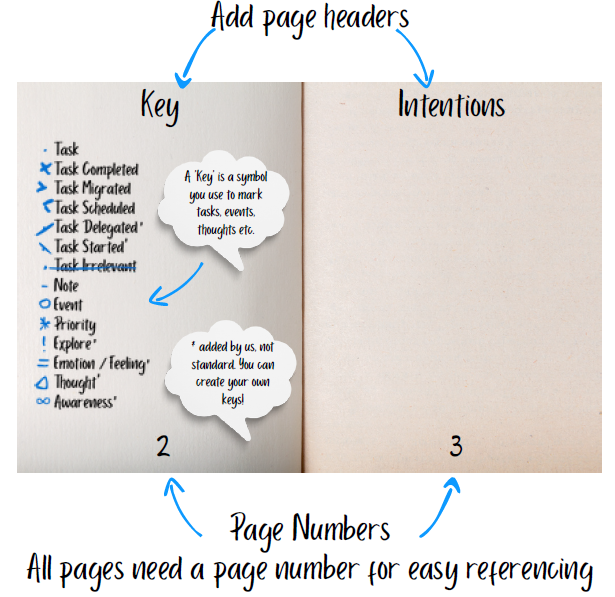
Step 1: Number Your Pages
Start by numbering every page in your journal. Yes, every one. This might feel tedious, but it’s essential – page numbers let you create an index, find things quickly, and reference past entries.
Tip: Number them all at once while watching a show or listening to music. Make it meditative rather than tedious.
Step 2: Create Your Key
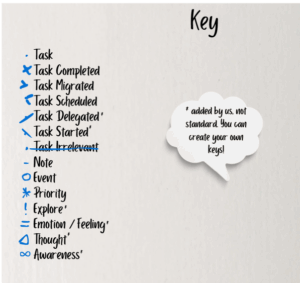
Your Key is your personal legend – the symbols you’ll use to quickly mark different types of entries. The beauty of the Bullet Journal is that you can customize these, but here’s a suggested starting point:
Task Markers:
•Task (to-do item)×Completed task>Migrated task (moved to another day/month)<Scheduled task (given a specific date)- / Task delegated
- \ Task started / engaged
—Task no longer relevant
Other Markers:
○Event—Note or observation*Priority or important!Inspiration or idea?Question to explore
Reflection Markers (Morphosis addition):
♡Gratitude or what brought joy⚡Insight or realization~Emotion to process△Growth moment or learning
Place your Key on the first page or inside the cover. You’ll refer to it often in the beginning, and it will become second nature over time.
Step 3: Create Your Index (2 pages)
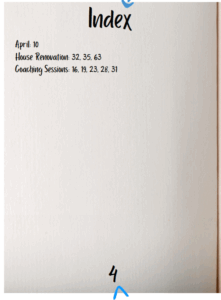
The Index is how you’ll find everything. Label the next two pages “Index” and leave them blank for now. As you create collections and logs throughout your journal, you’ll come back here and add them with their page numbers.
For example:
Future Log .................. 4-7
April Monthly Log ............ 10-11
Project: House Renovation .... 32, 35, 63
Coaching Reflections ......... 16, 19, 23, 28
Habit Tracker April .......... 12
Step 4: Set Up Your Future Log (4 pages)
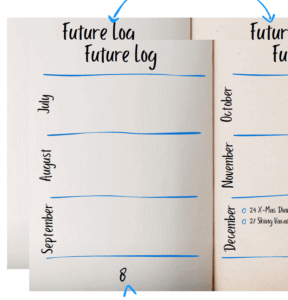
The Future Log is your year-at-a-glance. It’s where you capture events, deadlines, and intentions that are months away – things that don’t belong in your current monthly log yet.
Use the next four pages and divide them to show 3 months per page, giving you 12 months total. You can draw simple lines or boxes for each month. Keep it minimal – you just need enough space to jot down key dates.
Examples of what goes here:
- Birthday parties
- Vacation plans
- Project deadlines
- Annual appointments
- Workshops or events you want to attend
This isn’t meant to be your detailed calendar – it’s your big-picture view. When you set up each new month, you’ll migrate relevant items from the Future Log into that month’s log.
Step 5: Create Your Monthly Log (2-page spread)
Now you’re ready for your first Monthly Log. This is your month at a glance – both calendar and task list combined.
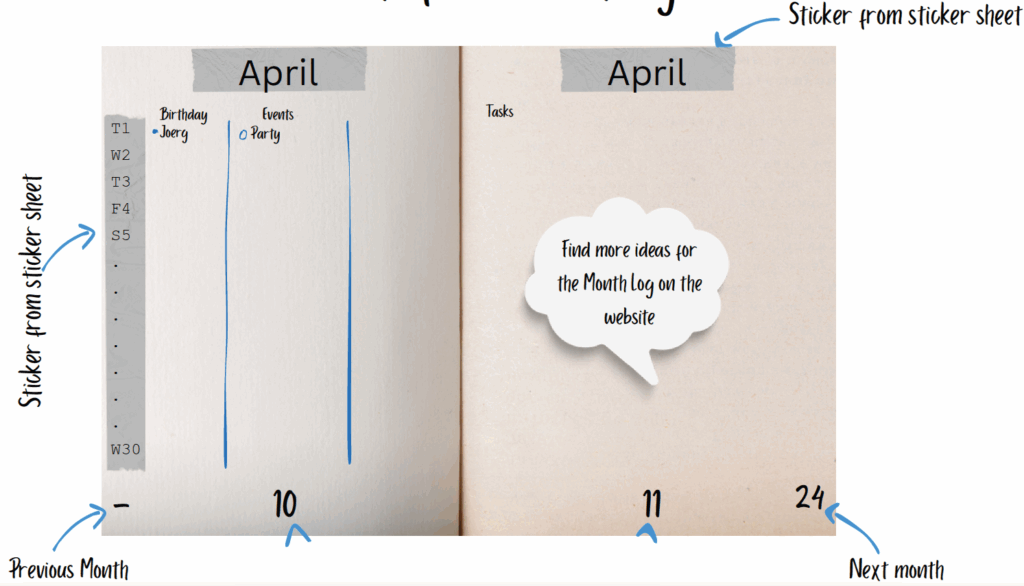
Left Page – The Calendar:
List all the days of the month down the left side with their corresponding day of the week. Next to each date, note any events or appointments. Keep it brief – just enough to remember what’s happening. To speed up the setup you will find a sticker sheet in the pouch at the back cover with stickers for month, days, and dates.
Example:
1  M
2  T
3  W  Team meeting
4  T
5  F  Date night
...
15 M  Doctor appointment
...
Right Page – Monthly Tasks & Goals:
This is your brain dump for the month. What do you want to accomplish? What needs to get done? Don’t worry about when – just capture everything here. You’ll schedule specific tasks in your daily logs.
You might also include:
- Monthly intentions or focus areas
- Goals you’re working toward
- Projects to make progress on
- Habits you want to build
Feel free to add a tracker to your Monthly Log Spread. I track daily expenses for example in a column at the right hand side of the page. Just divided by a line.
Step 6: Daily Logging
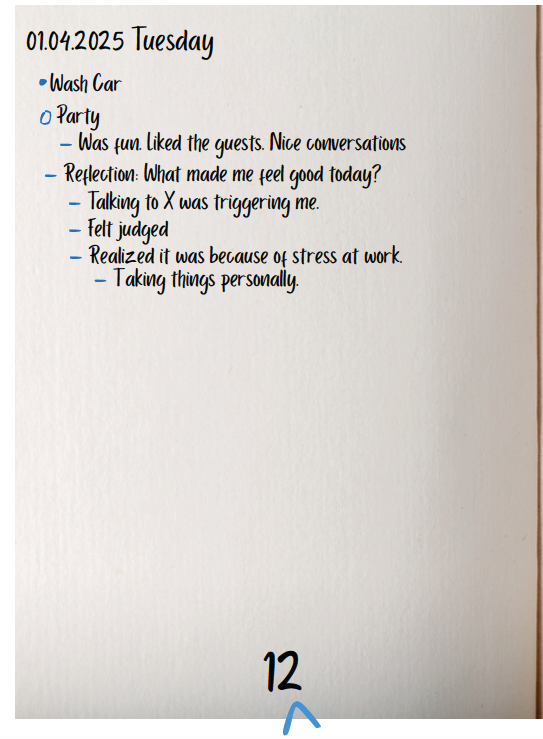
This is where the magic happens. Each day (or whenever you journal), create a simple header with the date and start logging.
Use your rapid logging with the bullets from your Key:
- Tasks you need to do
- Events that happened
- Notes and observations
- Reflections and insights
The beauty is that you can blend productivity with presence. Your daily log might include:
15.04.2025 Tuesday

* Call plumber about leak
* Finish project proposal
× Went for morning walk
— Team meeting was productive
♡ Grateful for sunny weather
⚡ Realized I've been avoiding difficult conversation with X
~ Feeling anxious about presentation
* Schedule 1:1 with manager
You’re tracking what needs doing AND what you’re experiencing. Both matter.
Reflection Prompts: At the end of each day or week, consider adding a brief reflection:
- What made me feel good today?
- What challenged me?
- What did I learn?
- What am I carrying that I need to let go?
I also use notes – to journal non-bullet style. Meaning longer stretches of reflective journaling on what comes to mind.
Step 7: Review and Migrate
At the end of each month, take time to:
- Review your monthly log – What got done? What didn’t? What are you noticing?
- Migrate incomplete tasks – For each unfinished task, ask: Does this still matter?
- If yes, move it to next month’s log (mark it with
>) - If it needs a specific date, schedule it (mark it with
<) - If it no longer matters, cross it out (mark it with
—)
- Reflect on the month – What worked well? What would you do differently? What patterns do you notice?
- Set up next month – Create your new Monthly Log, pulling relevant items from your Future Log
This monthly ritual keeps your system clean and your mind clear. You’re not carrying forward tasks out of guilt – you’re making conscious choices about what deserves your energy.
Layout Gallery: Ways to Use Your Journal
Beyond the core structure, your journal is infinitely flexible. Here are layouts and trackers that many people find valuable. Remember: create what serves you, when you need it. There’s no requirement to use all of these. You can also find tons of minimalist and very playful bujo examples in the Internet.
Habit Tracker
What it is: A visual grid to track daily habits over a month. Each row is a habit, each column is a day. Fill in the box when you complete the habit.
When to use it: When you want to build new routines or break old patterns. The visual feedback is powerful – you can see your consistency (or lack of it) at a glance. Useful for habits like exercise, meditation, reading, drinking water, taking vitamins, or anything you want to do regularly.
Why it helps: It creates accountability and makes progress visible. Missing a day isn’t failure – it’s information. What got in the way? What would help you get back on track?
[IMAGE PLACEHOLDER: Monthly habit tracker grid with habits listed vertically, days horizontally]
Mood Tracker
What it is: A way to track and visualize your emotional landscape over time. This could be a simple daily rating (1-10), color-coding different moods, or a more nuanced tracker with specific emotions.
When to use it: When you want to understand your emotional patterns better. Do you feel more anxious on certain days? Does your mood dip during particular weeks? Are there triggers you haven’t noticed? This data can be incredibly revealing in coaching work.
Why it helps: We often think we know how we’re feeling, but our memory is unreliable. A mood tracker gives you real data. You might discover that your “bad weeks” coincide with poor sleep, or that certain activities consistently lift your spirits. Knowledge is power.
[IMAGE PLACEHOLDER: Mood tracker with color-coded days or emotional ratings]
Gratitude Log
What it is: A dedicated space to regularly note things you’re grateful for. Could be daily, weekly, or whenever the spirit moves you.
When to use it: When you want to cultivate more appreciation and positive awareness in your life. Research shows that regular gratitude practice improves wellbeing, relationships, and resilience. It’s especially valuable during difficult seasons when everything feels heavy.
Why it helps: What we focus on expands. When you actively look for things to be grateful for, you start noticing more of them. This doesn’t mean toxic positivity or ignoring real problems – it means training your brain to also see the good alongside the hard.
[IMAGE PLACEHOLDER: Gratitude log page with dated entries]
Goal Tracker / Project Page
What it is: A dedicated page (or spread) for a specific goal or project. Include the vision, action steps, deadlines, resources needed, and progress notes.
When to use it: When you have a significant goal or project that needs focused attention – career transition, health journey, creative project, home renovation, learning a new skill. Breaking it into smaller pieces and tracking progress keeps you moving forward.
Why it helps: Big goals feel overwhelming when they’re just floating in your head. A project page brings structure and clarity. You can see what’s next, celebrate milestones, and notice when you’re stuck (which is valuable coaching data).
[IMAGE PLACEHOLDER: Project page layout with goal, action steps, timeline, and notes sections]
Weekly Spread
What it is: A two-page overview of your week, with space for each day’s tasks and events. Some people prefer this to daily logging because they can see the whole week at once and plan accordingly.
When to use it: When your week has a lot of moving pieces and you need the big picture. Great for balancing multiple projects, coordinating family schedules, or planning your week strategically rather than day-by-day.
Why it helps: It prevents overcommitting (you can literally see that Wednesday is already packed) and helps you distribute tasks more evenly across the week.
[IMAGE PLACEHOLDER: Weekly spread with sections for each day of the week]
Brain Dump / Mind Map
What it is: A free-form page where you spill everything that’s in your head. No structure, no organization – just getting it all out. Mind maps add a visual element, with ideas branching from a central theme.
When to use it: When your mind feels cluttered, when you’re working through a complex problem, when you’re brainstorming, or when you need to process emotions. Sometimes the best thing you can do is stop trying to organize and just let it flow.
Why it helps: The act of externalizing thoughts creates immediate relief. Once it’s on paper, you can look at it more objectively, spot patterns, and decide what actually needs your attention. Often, 80% of what felt urgent loses its grip once you see it written down.
[IMAGE PLACEHOLDER: Brain dump page or mind map example]
Sleep Tracker
What it is: A log of your sleep patterns – when you went to bed, when you woke up, quality of sleep, how you felt the next day.
When to use it: When sleep is an issue or when you’re curious about the connection between sleep and your energy, mood, or performance. Sleep affects everything, and tracking it can reveal surprising patterns.
Why it helps: You might discover that you sleep better on nights when you exercise, or that late-night screen time really does impact your rest. You might notice that your “low energy” days consistently follow poor sleep. This awareness empowers better choices.
[IMAGE PLACEHOLDER: Sleep tracker showing bedtime, wake time, and quality ratings]
Energy Level Tracker
What it is: Tracking your energy throughout the day or week – when you feel most alert, when you crash, what activities drain or energize you.
When to use it: When you want to work with your natural rhythms rather than against them. Understanding your energy patterns helps you schedule important work during peak times and protect low-energy periods for rest or simple tasks.
Why it helps: Many people try to force productivity all day long and wonder why they’re exhausted. An energy tracker shows you the truth: you have high and low times, and that’s normal. Plan accordingly.
[IMAGE PLACEHOLDER: Energy level tracker showing daily patterns]
Reading / Learning Log
What it is: A record of books you’re reading, courses you’re taking, podcasts you’re listening to – along with key insights, quotes, or reflections.
When to use it: When you’re actively learning and want to retain more of what you’re consuming. It’s easy to read a great book and forget the key lessons within weeks. Capturing insights as you go deepens learning and gives you a personal reference library.
Why it helps: It transforms passive consumption into active learning. Writing down what resonates makes it stick. Looking back at past reading logs can be surprisingly inspiring – “Look how much I’ve learned this year!”
[IMAGE PLACEHOLDER: Reading log with book titles, dates, and key takeaways]
Trigger & Pattern Tracker
What it is: A coaching-oriented page where you note situations that triggered strong emotions, your reactions, and what you’re learning about your patterns.
When to use it: When you’re doing deep self-awareness work. If you find yourself repeatedly reacting in ways you don’t like, this tracker helps you see the pattern clearly. When did it happen? What was the trigger? How did I respond? What was underneath the reaction?
Why it helps: Awareness is the first step to change. You can’t shift a pattern you haven’t named. This tracker makes the unconscious conscious, which is exactly where coaching thrives. Over time, you’ll spot your triggers before they activate, giving you choice in how you respond.
[IMAGE PLACEHOLDER: Trigger tracker with columns for situation, emotion, reaction, and insight]
Meal / Nutrition Tracker
What it is: Recording what you eat and how it makes you feel, used for exploring the connection between food and energy, mood, or health goals.
When to use it: When you’re curious about your relationship with food, working on nutrition goals, or investigating food sensitivities. Not about judgment or calorie counting (unless that serves you), but about awareness and patterns.
Why it helps: Many people discover surprising connections – that they feel sluggish after certain foods, that skipping breakfast affects their mood, or that they eat emotionally in specific situations. Information without judgment is empowering.
[IMAGE PLACEHOLDER: Meal tracker with space for meals and energy/mood notes]
Values & Priorities Page
What it is: A page where you articulate your core values and current priorities. What matters most to you? What do you want to guide your decisions?
When to use it: At the start of the year, during a major life transition, or whenever you feel misaligned. Also revisit it periodically – values evolve, and priorities shift with life seasons.
Why it helps: When you’re clear on your values, decisions become easier. You have a compass. Does this opportunity align with what I value? Is this commitment honoring my priorities? This page helps you say yes to the right things and no to everything else.
[IMAGE PLACEHOLDER: Values page with core values and current priorities listed]
Question Journal
What it is: A collection of powerful questions you’re sitting with. Questions you don’t have answers to yet, but that feel important to explore.
When to use it: Throughout your coaching journey or any time of significant growth or transition. Good questions are often more valuable than quick answers. Let them percolate.
Examples:
- What am I avoiding?
- What would I do if I weren’t afraid?
- What does success really mean to me?
- Who am I becoming?
- What needs to be released?
Why it helps: Questions create space for insight to emerge. You don’t need to force answers – just hold the questions gently and notice what surfaces over time. Often, the answer appears when you’re ready, not when you’re searching.
[IMAGE PLACEHOLDER: Question journal page with thoughtful questions]
Win Log / Success Tracker
What it is: A place to celebrate wins, big and small. What went well? What are you proud of? What did you accomplish?
When to use it: Regularly – daily, weekly, or monthly. We’re often so focused on what’s next that we forget to acknowledge what we’ve already done. This is especially important for people who struggle with self-criticism or imposter syndrome.
Why it helps: It builds confidence and combats the negativity bias our brains naturally have. It’s evidence that you’re capable, that you’re making progress, that effort yields results. On hard days, reading your win log reminds you of your strength.
[IMAGE PLACEHOLDER: Win log with dated accomplishments and celebrations]
Year in Review
What it is: A reflective spread at year’s end, looking back on the entire year. What happened? What changed? What did you learn? Who did you become?
When to use it: December or early January. Make it a ritual – pour a cup of tea, find a quiet hour, and really reflect. You can include highlights, challenges, growth moments, people who mattered, experiences that shaped you.
Why it helps: We move so fast that we rarely pause to see how far we’ve come. A year-in-review creates perspective. You’ll see patterns, celebrate growth, and gain clarity on what you want to carry forward and what you want to leave behind.
[IMAGE PLACEHOLDER: Year in review spread with sections for highlights, learnings, gratitude]
Making It Yours
These are just ideas – starting points. The real power of the Morphosis Reflective Journal is that it becomes uniquely yours. Create the pages you need. Skip the ones you don’t. Experiment. Make mistakes. Cross things out and try again.
There’s no perfect way to journal. There’s only your way – the way that helps you think more clearly, feel more deeply, and live more intentionally.
Some gentle reminders as you begin:
Start simple. Don’t feel pressure to create every layout right away. Begin with the basic structure (Index, Future Log, Monthly Log, Daily Logging) and add other pages as needs arise.
It won’t be perfect. Your handwriting will be messy sometimes. You’ll make mistakes. You’ll forget to update trackers. That’s okay. This isn’t about perfection – it’s about practice.
Less is often more. Don’t track so many things that the journal becomes a burden. Choose a few things that matter most right now. You can always add more later.
Trust the process. You might not “get it” immediately, and that’s normal. Give yourself a few weeks to find your rhythm. The practice deepens over time.
Be kind to yourself. This journal is a tool for growth, not self-criticism. Notice the harsh voice when it appears, and see if you can respond with compassion instead.
Your Invitation

You hold in your hands more than a notebook. You hold possibility.
The possibility to slow down in a world that moves too fast. To know yourself in a culture that encourages distraction. To create with intention in a life that often feels reactive.
This journal is your companion on that journey. Not because it has magical powers, but because you do. The magic is in the pausing. The noticing. The writing. The reflecting. The choosing.
One page at a time, you’re creating a record of your becoming.
Welcome to your practice. Welcome home.
May this journal support your growth, clarity, and transformation – one page at a time.